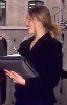
the assertive interviewee

Justine is 32, divorced with an 5-year old son and because the last thing she wants in life is to become stuck in a miserable job she's holding out for the perfect position.
What distinguishes Justine from other women is her incredibly observant powers and assertive presence.
"I became quite a master people reader as a result of being the baby of my family," explains Justine. "I'm sensitive to people's moods and environments generally. If I get a bad vibe from a place I'm outta there as fast as I can."
"I learnt everything I know from asking questions, watching others and generally checking out the lie of the land," says Justine.
"It was the only way I was going to survive in a family of seven. My big brothers and sisters gave me a hard time, but I grew up faster and smarter than they did. I will never allow anyone to boss me around, and I'm applying everything I learnt as a kid to help me find a good job."
"Sure I want to work and get real money," says Justine, "but when you've been pushed around a lot as kid - like I was - you don't want to repeat that history in a relationship or a job."
"I'd rather be a single stay at home mom than get pushed around by a guy or employer," says Justine. "It's as simple as that."
"And yes," concedes Justine, "that's why I stopped at one child. Life was tough for me and I wanted my son to have a good life. And by good life I don't necessarily mean money. I mean self-respect. I mean being your own person. So finding the right job is very important to me. I won't take any old job like some women do."
"Most women are so anxious and self-absorbed when they attend job interviews that they forget that their purpose in being there is not just to be interviewed." explains Justine. "I love job interviews because I act as an interviewer, too. I don't just sit there answering questions like a dummy. I ask questions, and plenty of them!"
Most importantly, though, Justine believes that attending interviews is the only opportunity we get, before it is too late, to get an inner view of the place where we've applied for a job.
Justine believes it's always a good idea to check the place out thoroughly before an interview appointment.
"I always do a trial run of the trip I'll have to make to the interview," explains Justine, "not just to familiarize myself with the route but also to imagine how I would feel doing that trip every day for maybe the rest of my life."
However, Justine explains that nothing is going to be as revealing as actually being in the building, getting an inner view.
"Because of security measures," explains Justine, "we are only likely to get an opportunity to do this at the time of our initial interview appointment."
"I'm always early for interview appointments," says Justine. "Not just to compose myself and visit the bathroom and do a final check of my appearance to see that no tags are hanging out or remains of breakfast are splattered on my shirt. I'm early primarily so that I can get an inner view of the building I'll be working in and the people I'll be working with."
Justine always makes a point to chat with the receptionist - he or she is always happy to chat with interviewees and answer any general questions. In fact, according to Justine, some companies include our contact with the receptionist in their appraisal of our suitability for the job.
"I'm always very careful what questions I ask the receptionist," laughs Justine, "and I don't assume that he or she is automatically going to be on my side."
"Also," adds Justine, "as I'm sitting in the reception area, I take a good look at the people passing by. I know that they will be taking a good look at me, too! Do they look stressed or happy? Do they dress formally or casually? Can I imagine myself working alongside them?"
"The only parts of the building we are likely to have access to at the interview," says Justine, "are the washrooms and the reception area, but a great deal about the company can be gained from these two areas. Is the washroom clean and modern and well lit? Do the cubicles have toilet paper?"
"Don't laugh," explains Justine. "If you have ever worked for a company that fails to provide toilet paper then you know exactly what to look for."
"Check out the reception area," advises Justine. "Is it spacious, bright and welcoming? Are the chairs comfortable?"
Nobody is going to get a good first impression of a company with a cramped, dark reception area with cold, hard seats, or even a reception area that looks like a brothel with mood lighting and plush chairs.
"I always pay attention to reception areas," says Justine, "because if it is inhospitable or strange I can imagine how awful my working area is going to be like. If that's how the company welcomes visitors, then how do you think it will treat staff?"
And, when she is finally called in to be interviewed, Justine believes in taking advantage of this opportunity to get an inner view of the working part of the building and the people she is likely to be working with.
"The interviewers will be doing their best to get an inner view of us by our grooming, dress and the way we walk and talk," explains Justine, "so I check them out, too!"
Justine maintains that the people who interview us are likely to be the company's 'face'. If she doesn't like their faces, then she will have a very clear inner view of what the company itself is like.
"First impressions," concedes Justine, "are not always a good indication of the value of anyone or anything - but that is how job applicants are being judged and if I'm rejected after the first interview then it is very comforting to remember that the washroom didn't have any toilet paper and that working there just wouldn't flush with me at all."
Labels: assert yourself, interviews, people reader, perfect position, reception area